
Microsoft Voluntary Exit Offer: A Deadline, Not a Decision

A voluntary exit window gives you a date to decide by. It doesn't tell you what to decide, and that gap is where careers stall.
If you're a senior leader, you may never get a layoff notice with your name on it. You're more likely to get an email with an offer: leave now, with support, if you choose to. It sounds like freedom. It's a clock.
That's what Microsoft put in front of about 60,000 employees, roughly a quarter of its workforce, when it announced a voluntary exit offer, the program, most coverage is calling a buyout, for participating teams in the U.S., the U.K., Canada, and India. Eligibility runs to level 70 and below, a ceiling that reaches the vice president level. Microsoft's memo calls it a time-limited program that includes financial support and career-planning resources.
Microsoft isn't the first to do this. In 2025, the federal government offered its workforce deferred resignation, starting with the "Fork in the Road" email in January. GAO reports that about 144,000 employees were approved for deferred resignation in the first half of that year. Google ran a voluntary exit program for its hardware teams that same year, then extended it to several more divisions. And Microsoft's own year shows what can come next: its first-ever voluntary retirement program in the spring was followed by about 4,800 job cuts in July.
Whether you're one of those 60,000 or you work anywhere a window like this could open, here's what I want you to see before the window does.
A deadline is not a decision
A voluntary window hands you a date. It doesn't hand you an answer. It forces a choice on someone else's timeline, and underneath it sits one question: do you already know what you'd say yes to next?
If you do, the offer is a runway. If you don't, it's a gamble with an expiration date. You end up weighing a known package against an unknown future, and an unknown future is very hard to price.
These decisions do get made. When Microsoft ran a voluntary retirement program a few months earlier, about 30 percent of eligible employees took it. Every one of them had to decide by a date they didn't choose.

Without direction, two easy mistakes can happen. You stay because leaving feels like jumping, and the next round arrives with fewer options attached. Or you take the money and spend the first months of severance figuring out what you want, which is the most expensive time to do it.
A check isn't a plan
Microsoft paired the money with career planning, and that matters. A severance package answers one question: how long can I afford to look? It leaves the bigger one open: look for what?
A check buys time. It doesn't tell you which roles to pursue, how to explain your move, or why a hiring company should see you as the answer to its problem rather than one more senior resume in the stack.
I spent 20 years as an award-winning executive recruiter before I founded Soar Career Services in 2016, and I can tell you the person reading your resume gives it 6 to 10 seconds. More months on the calendar don't buy you more seconds on the page.
Don't wait for the window
A window like this can open with very little notice, at Microsoft or anywhere else. When it does, the clock runs on the company's schedule, not yours. The best time to know what you'd say yes to is before anyone asks!
If any of this sounds like where you are, let's talk before the window opens. Book a complimentary virtual meeting with me, and I'll look at where your search stands today and tell you what it needs, so the next offer that lands in your inbox is a choice you're ready to make.
Choose a time that works best for you using the following link: https://calendly.com/d/cqjs-96t-yq3
What a voluntary exit offer should find already in place
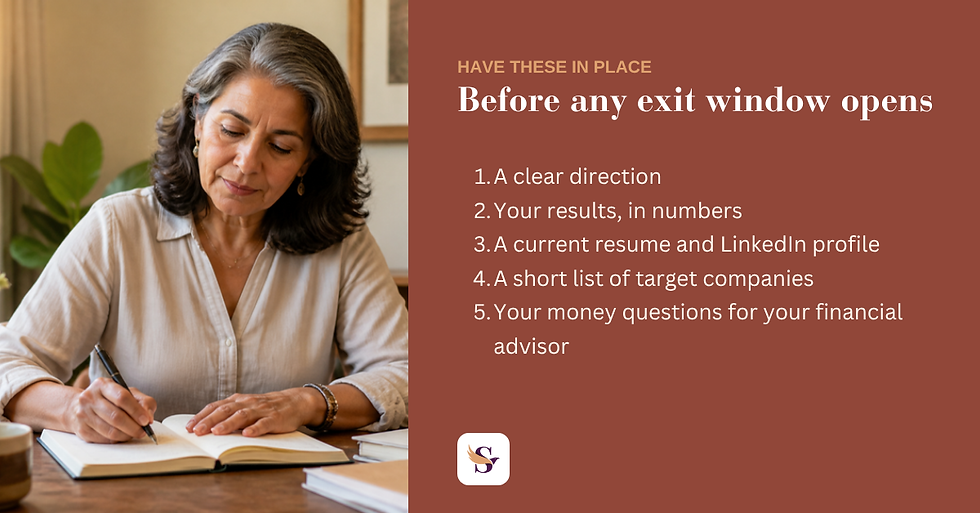
The leaders who handle these windows well aren't the ones who move fastest after the email lands. They're the ones who had their answer before it arrived. Ready looks like this:
A clear direction. A career map that shows where you're headed next and why, so the offer can be measured against something real.
A written record of your results, with numbers. Outcomes, not duties, in figures someone outside your company can understand.
A current resume and LinkedIn profile. Not the version from your last move: one that reflects your current level and the role you want next.
A short list of target companies. Not everyone who's hiring. The few where your experience solves a problem they actually have.
Your money questions, written down for your own financial advisor. How long pay continues, what happens to unvested stock, health coverage, and what the timing means for your taxes. Those answers belong to your advisor, and you want them before you decide, not after.
Every item on that list takes longer to build than most people expect. None of it should be rushed, because a resume written against a deadline reads like one.
For HR and business leaders: the people who stay are watching
If you're the one offering a window like this rather than weighing it, remember who else is reading that email. The people who stay are watching how the people who leave are treated.
They notice whether departing colleagues got real transition support or a link and a date. They notice whether leaders talked about the offer honestly. And they draw their own conclusions about what the company will do for them when it's their turn.
A voluntary program handled with care protects the trust of the team you're counting on to carry the work forward. Handling it as a headcount exercise teaches your strongest people to keep their options open. That cost never shows up in the severance budget, and it outlasts it.
Bobbiette Swanson is the founder of Soar Career Services, which she launched in 2016 after twenty years as an award-winning Certified Senior Executive Recruiter and nearly three decades in careers and hiring. She writes executive resumes, optimizes LinkedIn profiles, and coaches senior professionals through career transitions, drawing on best practices across multiple industries. She leads the writing and strategy for every client engagement.


Comments